The architecture repository that proves its answers.
Cairns turns the documents and systems of record you already have into one governed architecture model, keeps it current as they change, and proves every answer back to its source. A cairn is the marker a party leaves so the next one finds the way. That is what your architecture information should do for every initiative that follows.
The problem it is built for
Architecture truth does not live in architecture tools. It lives in design documents, board minutes, spreadsheets and diagrams that drift out of date the week they are written. The structured systems hold what they hold; the documents hold what everyone actually decided. Conventional platforms assume the repository is fed from structured sources and kept honest by stewards, so every new initiative starts with the same discovery and validation exercise, billed again.
Cairns starts from the other end. It ingests the documents as well as the systems, pins every source, and keeps the model current as the corpus changes. Restatements are shown, never overwritten.
Four planes
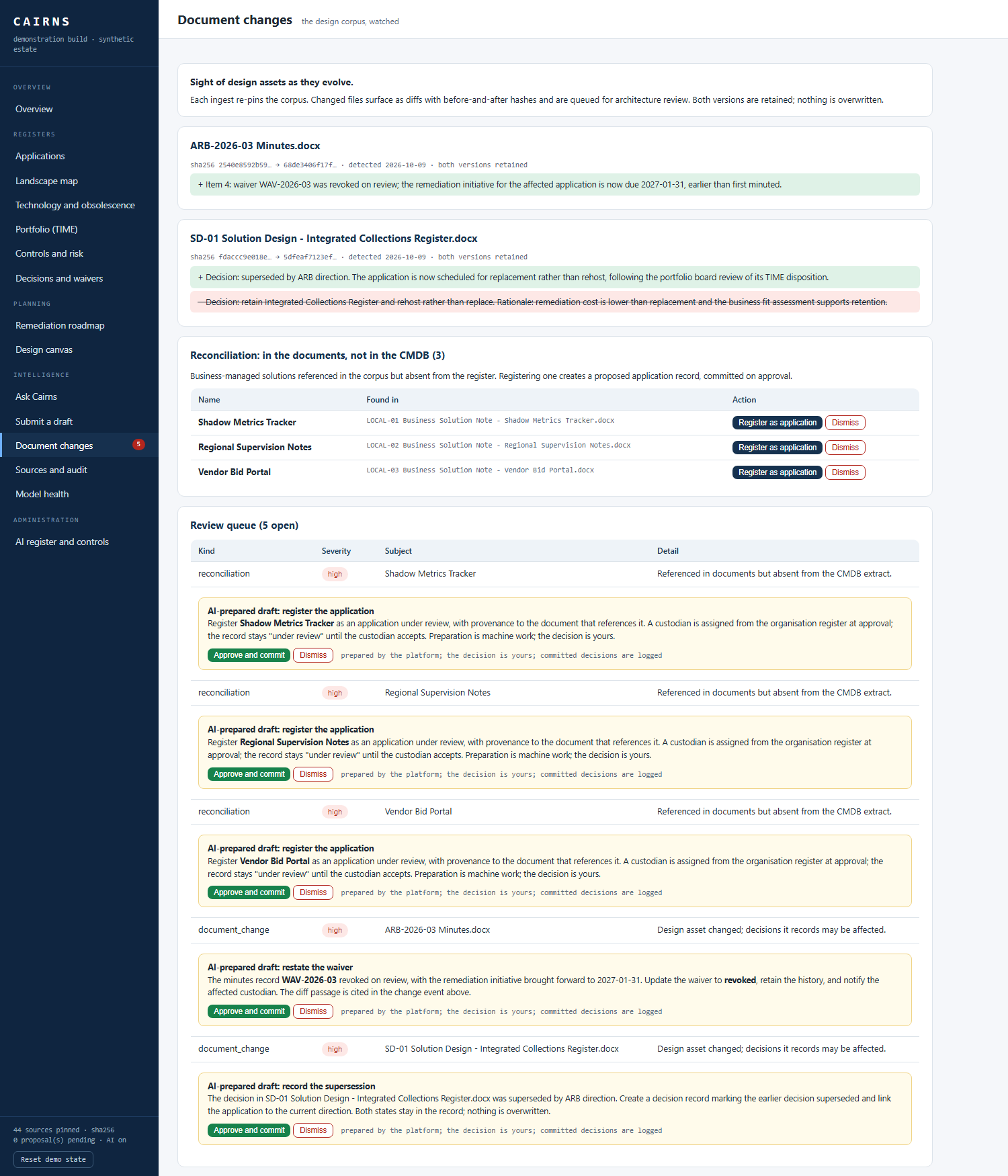
Connectors for the systems of record, and governed ingestion of the design corpus: Word, PowerPoint, Visio, minutes. Extraction resolves against the metamodel; ambiguous or conflicting material goes to a review queue, never silently in.
A governed model of applications, capabilities, data, technologies, controls, risks, decisions and roadmaps. Declarative metamodel, versioned branches for target states, every element carrying its provenance pin.
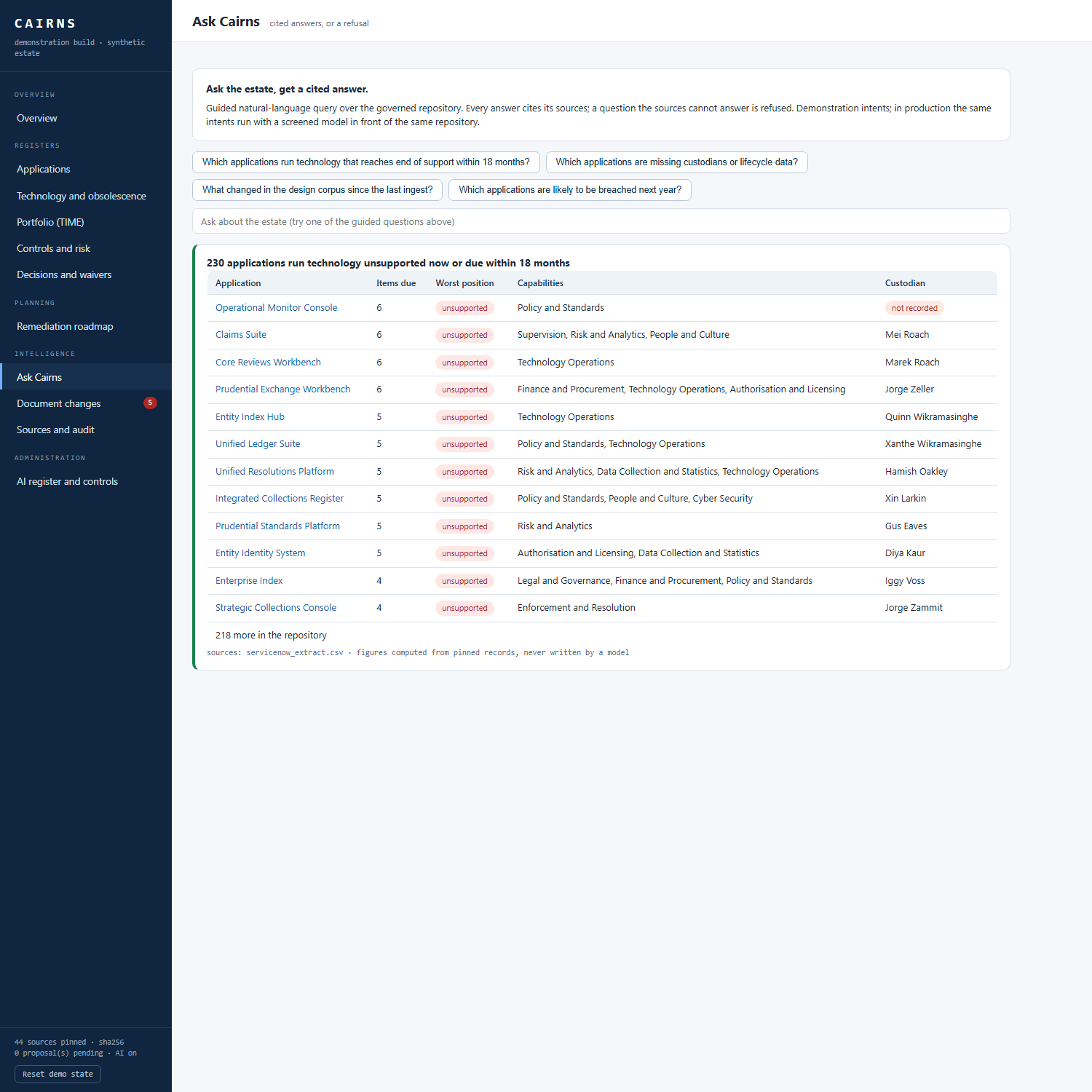
Natural-language query and assistance over the repository. Deterministic screening before any model call. Answers cite their sources or refuse. Figures are computed, never written by a model. Open-weight models inside your boundary; model choice is configuration.
Role-appropriate views for architects, contributors and consumers. The consumer cohort never sees a modelling notation: they ask questions and get cited answers, or they read dashboards built for their role.
Proof, not slideware
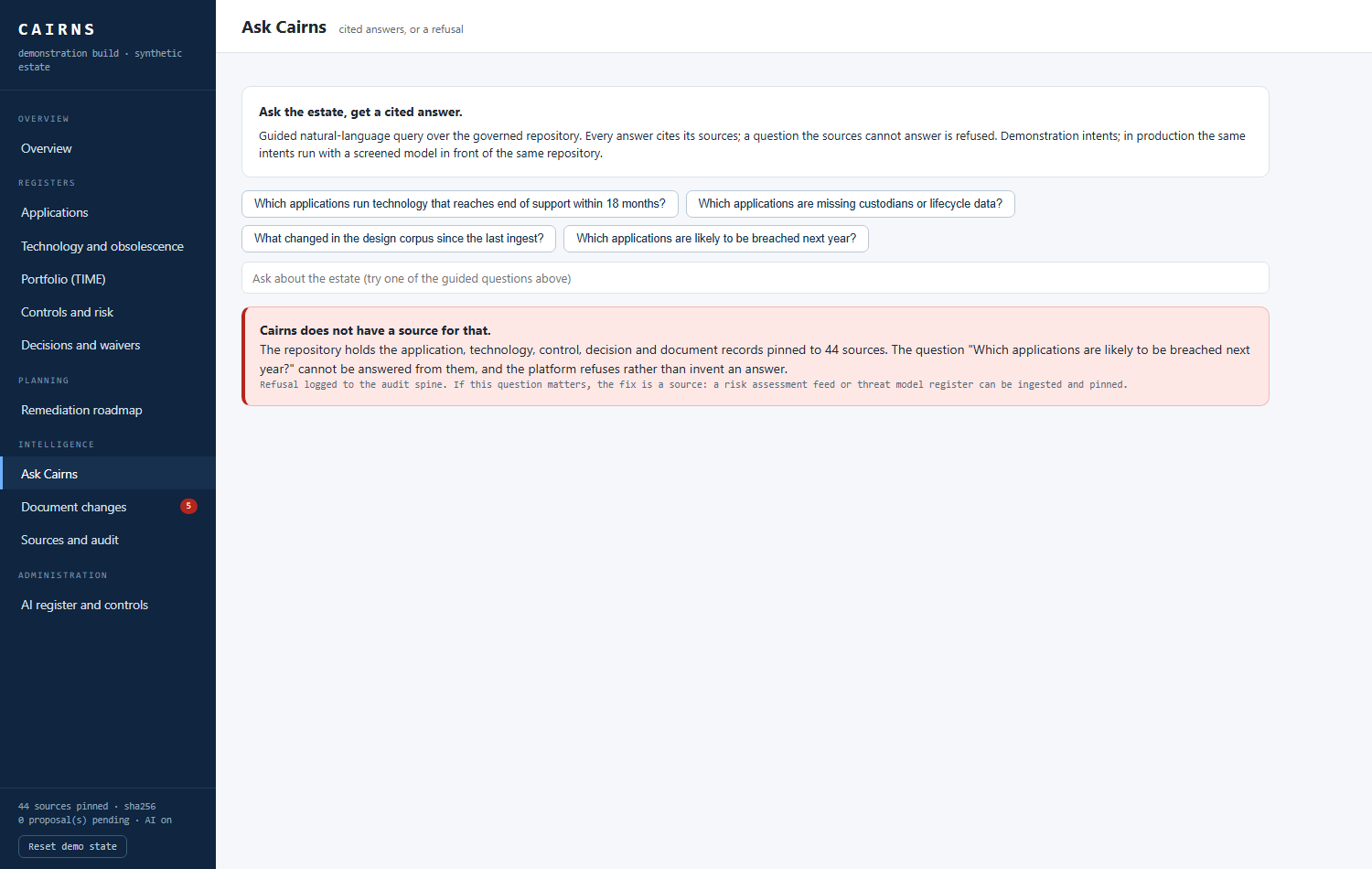
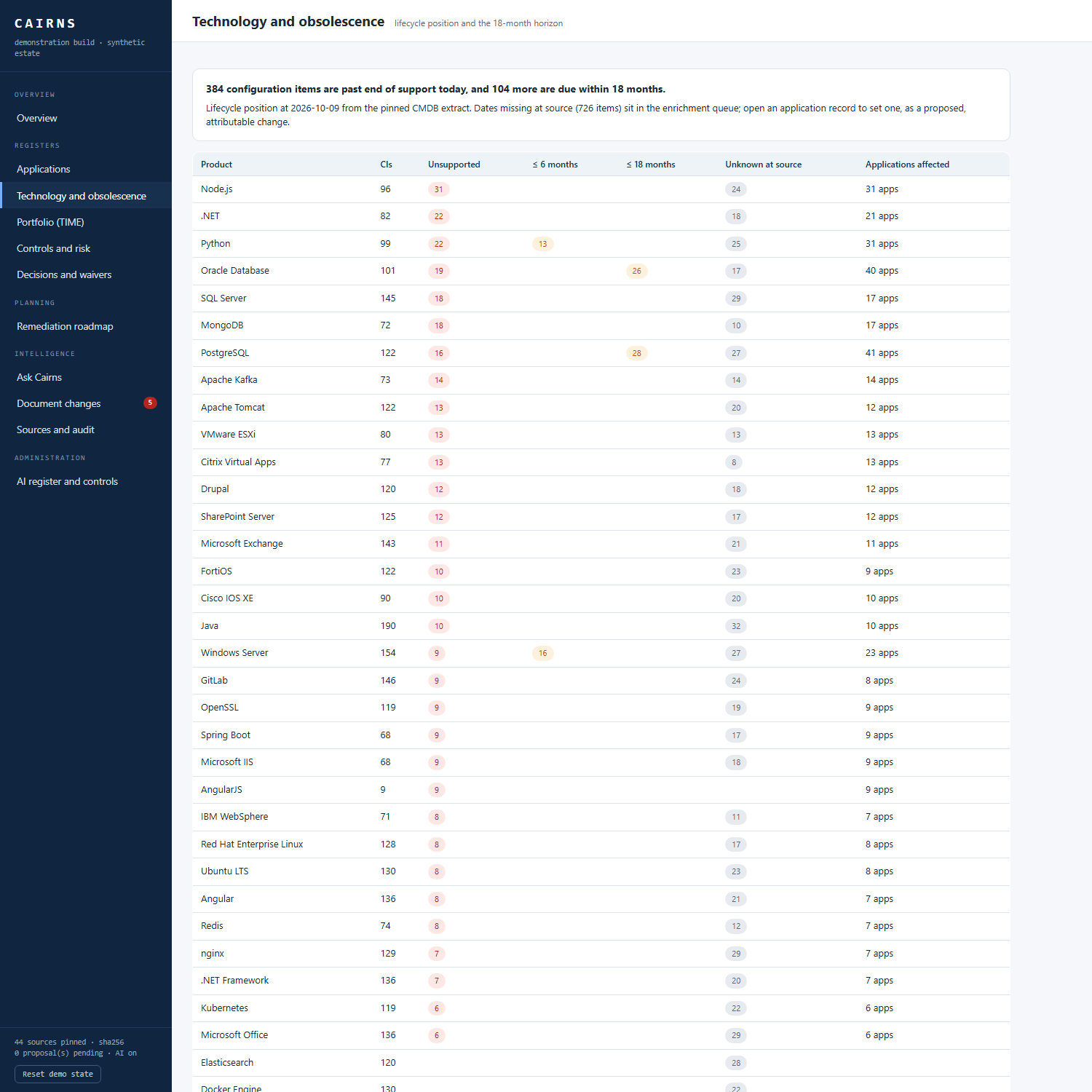
The figures below are captured from the running demonstration build on a fully synthetic estate at the scale of a Commonwealth regulator. The same build is what we bring to a demonstration. Every record is synthetic; every element traces to a pinned source.
Narrated rehearsals
Two short recordings of the running build, narrated end to end. The narration is synthetic; the live demonstration carries a human presenter. Every figure in them is computed from pinned sources.
The full figure set, including the estate dashboard, TIME portfolio quadrant, remediation roadmap and the AI register, is in the demonstration annex. Better: walk the trial yourself.
AI you can defend
- Every AI feature is listed in a standing disclosure register: the model it uses, the data it processes, retention behaviour, and its individual switch.
- A master switch disables AI assistance entirely. The platform, search, dashboards and workflows continue normally.
- All inference runs inside your hosting boundary on open-weight models. No estate data trains any model. That is a contract term, not a configuration promise.
- Deterministic screening runs before every model call: scope, injection, identity. The screen is code, not a prompt.
- Answers cite sources that resolve, or they refuse. The refusal is logged.
- AI processing remains within Australian regions.
This control layer is not new for the product. It has been hardened over more than two years and 500,000-plus automated review cycles, and it runs in production today in Commonwealth-facing services.
Security and sovereignty
| Position | Detail |
|---|---|
| Deployment | In-tenancy, or Hosting Certification Framework Certified Assured hosting in Australian regions. Provider, region, tenancy and isolation disclosed. |
| Data sovereignty | All data, backups, logs, metadata and AI processing remain within Australian regions or inside your boundary. |
| Identity | Microsoft Entra ID federation, MFA, SCIM provisioning, role and attribute-based access on least privilege. |
| Assurance | Controls designed against the ISM, PSPF and Essential Eight. Workload assessment up to full IRAP is scoped into implementation, with the assessor-facing evidence pack shipped with the platform. |
| Audit | Hash-chained audit spine with signed checkpoints; verification you can run without us. |
| Exit | Full export of data, models, metadata and configuration in documented formats. Exit costs you your own effort and nothing else. |
Contact
The demonstration build is public and self-guided. For a walkthrough, a demonstration against your scenarios, or the full response annex, write to us.